Harnessing the Power of Capitalism
Almost every client conversation I have at the moment contains a version of the same sentence. It usually arrives about twenty minutes in, often with a slightly apologetic laugh:"It all feels a bit fragile out there, doesn't it?"
I understand entirely. Read the headlines for ten minutes and it is difficult not to conclude that the world is becoming more uncertain, more divided and generally more precarious than it used to be. The twenty-four-hour news cycle is very good at making progress feel like it has gone into reverse.
The trouble is that the evidence says something quite different.
The world is getting better, quietly
Since 1990, the number of people living in extreme poverty has fallen from around 2.3 billion to roughly 831 million. Deaths of children under five have fallen from around 12.5 million a year to fewer than 5 million. More than two billion additional people now have access to safely managed drinking water. Life expectancy, literacy and access to electricity have all improved materially over the same period.
None of that made the news, because gradual improvement never does. But stretch the lens back to 1800 and the picture is genuinely remarkable: people today live longer, healthier and wealthier lives than at any point in human history.
A significant contributor to that progress has been capitalism. And for investors, that matters enormously — because capital markets offer an ordinary person a very straightforward way to participate in it.
The figure below tracks the improvement in both wealth and health around the world from 1800 to 2025. People today live longer, healthier and wealthier lives than at any point in human history. The scale of this progress is remarkable.
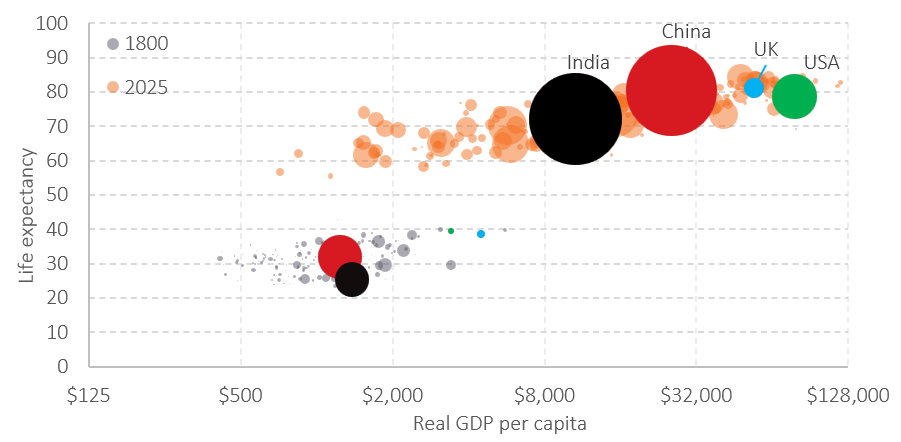
Source: Albion Strategic Consulting. Data source: gapminder.org. Bubble size corresponds to population size
What you actually own
This is the bit I find clients most enjoy discussing, because it gets away from the abstraction of "the market".
When you buy shares, you are not buying a ticker symbol or a line on a statement. You become a part-owner of real businesses. Businesses that employ people, develop products, provide services and try to make a profit. As they grow and create value, you benefit through dividends and rising share prices.
Own a properly diversified portfolio of global companies and you are participating in the collective ingenuity and productivity of thousands of businesses, in dozens of countries, every single working day.
That is a far more reassuring way to think about a portfolio than watching an index tick up and down.
"Surely it can't keep going?"
There is a curious instinct among investors — and I include myself here — to believe that good things cannot continue indefinitely. After a long run of rising markets, a setback starts to feel not just possible but overdue.
Yet there is little evidence to support that conclusion. Progress does not become less likely simply because it has been going on for a long time.
The future may turn out better than today, worse than today, or simply different. Nobody honestly knows. Our job as investors is not to predict which of those arrives. It is to position ourselves so that, if human ingenuity and enterprise continue to push society forward, we participate in the result.
Capitalism is flawed. It is also extraordinarily effective.
I am not going to pretend capitalism is perfect, and clients who raise its shortcomings are not wrong to do so. But as a wealth creation mechanism it has proved remarkably effective.
The pursuit of profit has driven innovation after innovation that has improved how we live — from advances in medicine and communications through to the more recent developments in artificial intelligence. Nobody can sensibly predict who the eventual winners and losers from AI will be. What its rapid adoption does tell us is that the incentives created by competitive markets are still driving investment, innovation and productivity right across the global economy.
The takeaway
Progress will not arrive in a straight line, and neither will investment returns. Expecting otherwise is the fastest route to disappointment.
But history is fairly unambiguous on one point: betting against the long-term adaptability and resilience of capitalism has generally been a poor trade.
So when a client tells me the world feels fragile, my answer is not that everything is fine. It is that the mechanism we are relying on — human beings solving problems, competing, innovating and building businesses — has survived considerably worse than today's headlines.
Trust the process. Own the businesses. Stay the course.