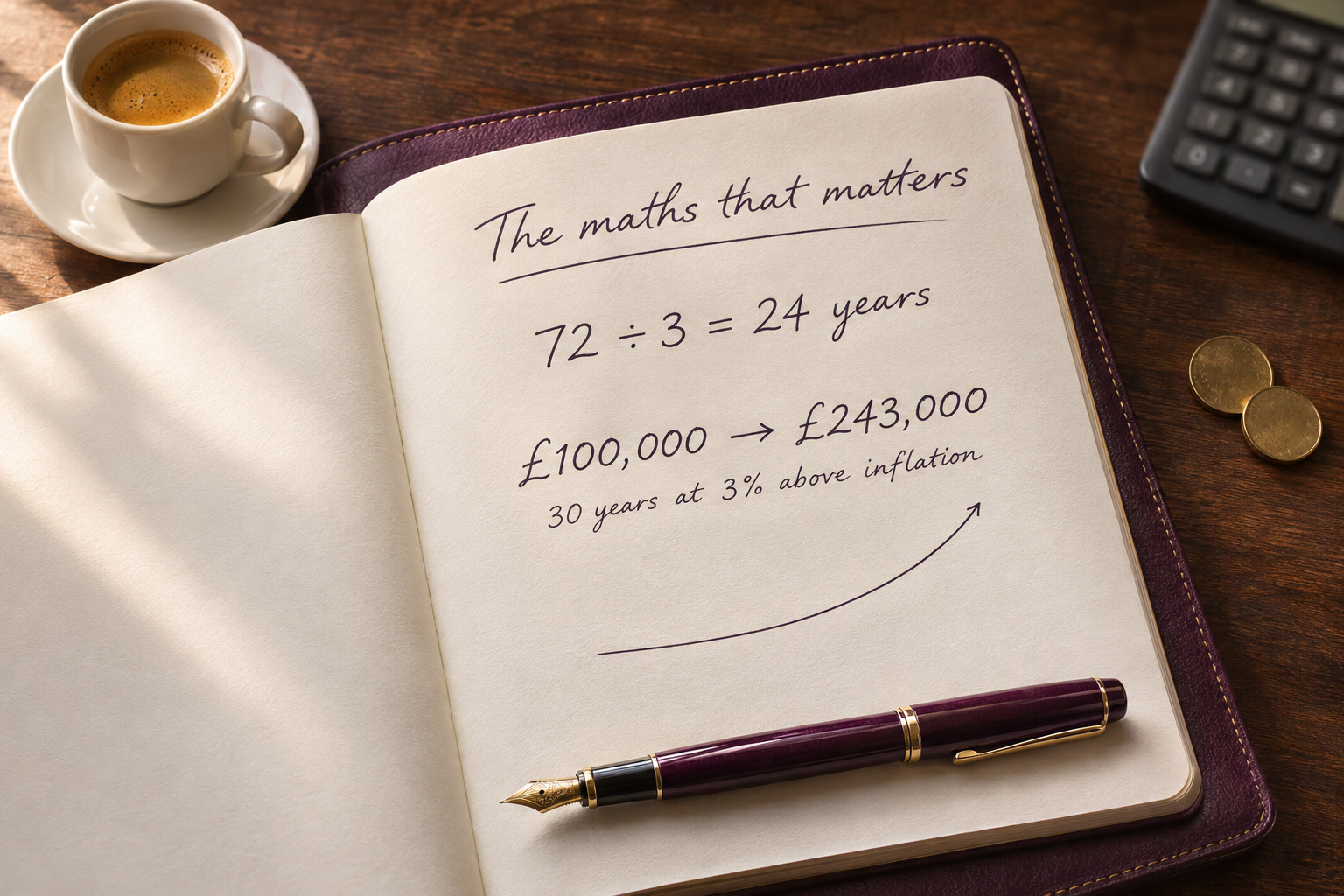
You don’t need to be good at maths to be a good investor. But understanding a few surprisingly simple numbers can make an enormous difference.
I have a confession to make. I have spent nearly three decades working in financial services, yet I cannot remember the last time I needed trigonometry.
Or algebra. Or calculus.
Perhaps all those hours staring rather blankly at a blackboard weren’t quite as important as my maths teacher suggested.
But there is some maths that matters enormously when it comes to money. And the good news is that most of it is remarkably simple.
It tells us something about time, patience, inflation, investment costs and risk. More importantly, it helps explain why some of the least exciting investment decisions can ultimately be the most powerful.
So, pencils out. No calculators required.
The most valuable ingredient might simply be time
Financial planning is really an exercise in joining up two things: the resources we have today and the life we want to fund tomorrow.
That means making assumptions about saving, investment returns, inflation, tax and ultimately how much we can sustainably spend.
Modern financial-planning software can crunch most of those numbers for us.
But one principle is worth understanding ourselves:
Compounding.
Imagine somebody wanted to accumulate £1 million in today's money.
The amount they would need to invest each month changes dramatically depending on how much time they give themselves. At an assumed 3% annual return after inflation, for example, the approximate monthly saving required falls from £7,200 over ten years to £3,100 over twenty years and £1,700 over thirty years.

Table 1: Approximate monthly contribution required to build £1,000,000
Source: Albion Strategic Consulting. Contribution assumed at end of month. Figures rounded to nearest £100.
That is a staggering difference.
And it explains why one of the best financial gifts we can give our children and grandchildren isn't necessarily money itself.
It's time. The earlier money is invested, the longer its returns have the opportunity to generate further returns. Starting early is usually far more powerful than trying to play catch-up later.
Small numbers can produce very big numbers
Financial headlines love enormous numbers.
Billions. Trillions. Multi-billion-dollar movements in stock markets.
Against that backdrop, an investment return of 3% or 4% above inflation can sound rather underwhelming.
But small numbers become much more interesting when you give them time.
Take £100,000 invested for 30 years. At an annual return of 1% above inflation, it would grow to approximately £135,000 in today's purchasing power.
At 3%, it becomes around £243,000.
At 5%, approximately £432,000.
Same £100,000.
Same 30 years.
Very different outcomes.
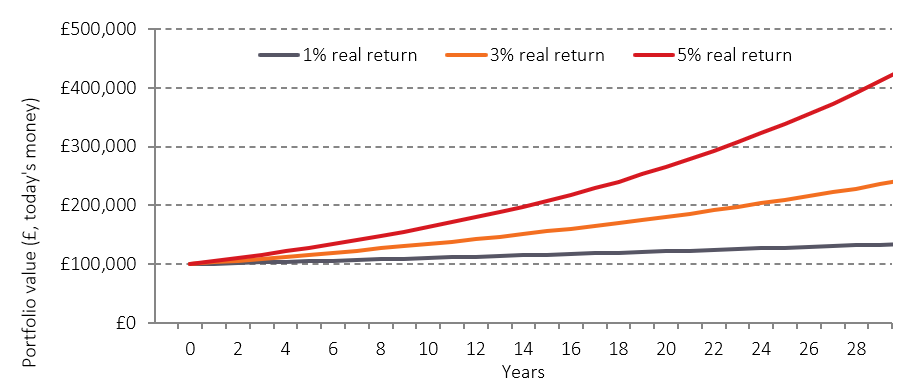
Figure 1: Compounding is a powerful concept
Source: Albion Strategic Consulting
This is why investing is rarely about finding the next spectacular investment. For most people, getting rich slowly is a perfectly good strategy.
Trying to accelerate that process usually means taking considerably more risk.
The Rule of 72
Here is possibly the most useful bit of mental arithmetic in investing.
It's called the Rule of 72.
Take 72 and divide it by your assumed annual compound return. The answer gives you a rough idea of how many years it might take your money to double.
So:

Table 2: Years to double your money at different rates of return
Source: Albion Strategic Consulting
Of course, markets don't deliver returns in neat straight lines. Higher expected returns generally involve accepting a bumpier journey and greater uncertainty along the way.
But the Rule of 72 provides a lovely illustration of the relationship between return and time.
And unfortunately, it works in the opposite direction too.
Inflation: the quiet thief
We tend to notice when investments fall by 10%.
We notice rather less when inflation quietly takes 2% or 3% from the purchasing power of our money each year.
Yet given enough time, the effect is enormous:

Table 4: The erosion of purchasing power of capital by inflation
Source: Albion Strategic Consulting
This matters particularly for people holding substantial sums of cash.
Cash can feel safe because the number printed on the bank statement doesn't fall.
But the real question isn't simply:
“How many pounds do I have?”
It's:
“What will those pounds buy me?”
Protecting purchasing power is one of the fundamental reasons we invest for the long term.
Costs compound too
There is another number investors should pay attention to: cost.
A fraction of a percentage point may not sound terribly significant in any individual year.
Over several decades, it can be.
Investment fees, taxes, unnecessary transactions and poor investor behaviour can all reduce the return an investor actually keeps.
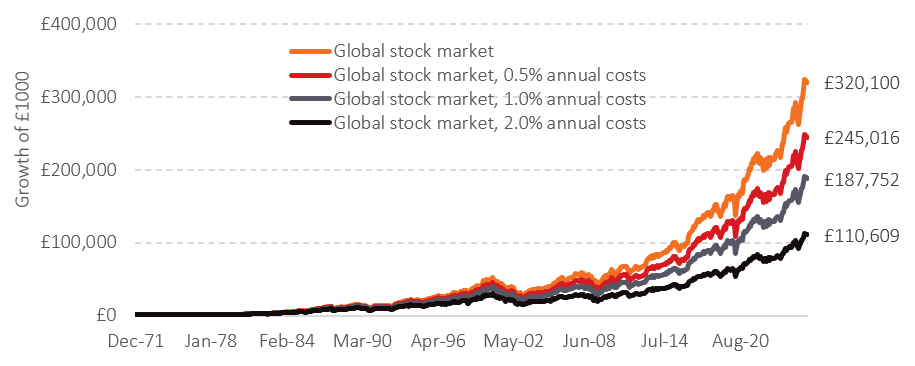
Figure 2: Compounding costs makes a big difference – the impact on stock returns
Source: Albion Strategic Consulting. Period: 01/72 - 12/25. Equities: Albion World Stock Market Research Index. Returns in GBP. See smartersuccess.net/indices for more information.
This is sometimes overlooked.
We spend a lot of time discussing what investments might return.
But ultimately it is the return you keep that matters.
And one of the most expensive investment behaviours of all can be repeatedly jumping in and out of markets as sentiment changes.
Sometimes doing less really is doing more.
Risk has its own maths
There's one final mathematical curiosity worth understanding.
Consider two imaginary portfolios.
One falls 25% in year one and rises 25% in year two. Another falls 10% and then rises 10%.
The average annual return of both is technically zero. Yet neither investor gets back to where they started.
£10,000 invested in the first would finish at £9,375.
The second would finish at £9,900.

Table 5: Reducing volatility in a portfolio pays
Source: Albion Strategic Consulting
Why?
Because investment losses require disproportionately larger gains to recover.
Lose 10% and you need an 11.1% gain to get back to where you started.
Lose 25% and you need 33.3%.
Lose 50% and you need 100%.
This is one reason sensible diversification matters.
It isn't about removing risk. That's impossible.
It's about avoiding unnecessary concentrations and building a portfolio whose inevitable ups and downs are consistent with the journey you are trying to fund. The underlying maths demonstrates that lower volatility, all else being equal, can reduce the drag on compounded returns.
So what does the maths actually tell us?
Perhaps the most interesting thing is how unexciting the answer is.
There isn't a clever formula.
There isn't a secret investment strategy.
There certainly isn't a shortcut.
The maths essentially tells us to:
Start early.
Give compounding time to work.
Don't dismiss small differences in returns.
Keep unnecessary costs under control.
Don't underestimate inflation.
Diversify.
….And build an investment strategy you can actually stick with when markets inevitably become uncomfortable.
None of those ideas will generate many sensational headlines.
But over an investment lifetime, they can make a very substantial difference.
Perhaps maths wasn't so boring after all.
The takeaway
Successful investing doesn't require advanced mathematics. It requires understanding a handful of simple principles and having the patience to let them work.
Time is enormously powerful. Small differences compound. Costs compound too. Inflation quietly erodes purchasing power. And avoiding unnecessary risk can be every bit as important as chasing additional return.
Good financial planning brings those things together.
Not to produce the biggest number possible.
But to give you the best chance of having the money you need, when you need it, for the life you actually want to live.