
There’s a temptation in investing to want every part of your portfolio to be working as hard as possible.
If one investment is offering a little more return than another, why wouldn’t you go for it?
Well, sometimes the answer is that you need to understand what that investment is actually there to do.
And nowhere is this more important than with bonds.
Bonds have had a pretty miserable few years. Rapidly rising interest rates in 2022, followed by inflation that proved rather more stubborn than many expected, created a difficult environment for bond investors. It was not exactly their finest hour.
There is, however, a silver lining. Bond yields are now considerably higher than they have been for much of the period since the global financial crisis. In simple terms, investors are being paid more to lend their money than they were for most of the last two decades.
That sounds attractive. And it is.
But it’s worth taking a step back and asking a more important question:
What job are bonds supposed to do in your portfolio?
Not everything in your portfolio needs to be exciting
For most long-term investors, shares – or equities – are the main engine of investment growth. They give you an opportunity to participate in the growth of businesses and economies over time.
But they come with a price. Markets can fall, sometimes sharply, and nobody enjoys watching the value of their investments take a hit.
That’s where bonds come in.
Their role in a portfolio is often rather different. They are there principally to provide some stability when equity markets come under pressure. Think of them as the defensive part of the portfolio – a bit like an insurance policy.
And just as you probably wouldn’t buy insurance based purely on the promise of a higher return, it’s worth being careful about how much risk you take with this part of your investments.
The trouble with making bonds too exciting
There are two main ways investors can try to squeeze more return out of bonds.
The first is to lend money for longer. In return for doing so, investors may receive a higher yield, but the price of those bonds becomes more sensitive to changes in interest rates.
The second is to lend to companies rather than governments. Companies generally have a greater risk of getting into financial difficulty and failing to repay their debts. Investors expect to be compensated for taking that additional risk.
Neither approach is necessarily wrong. Taking a little more risk can make sense in the right circumstances.
For example, investing in short-dated, high-quality bonds rather than holding everything in cash may offer the prospect of a better return without taking an unreasonable amount of additional risk.
But there is a danger in pushing too far.
If you lend to lower-quality borrowers, those borrowers may come under pressure at exactly the same time as the stock market. If you lend for longer periods, rising interest rates can cause bond prices to fall.
Do both, and you can end up with a supposedly defensive part of your portfolio that is behaving rather like the risky part.
Which rather defeats the object.
What happens when markets fall?
This is where the numbers become interesting.
We looked at how different types of UK bonds behaved during months when global stock markets were falling. The analysis covered the period from June 1994 to October 2026.
The results are revealing.
During the 58 months in which global equities fell by more than 3%, short-dated UK government bonds – known as gilts – delivered an average return of +0.4%.
Short-dated corporate bonds, which involve lending to companies, returned an average of -0.2%. Broader UK corporate bonds returned -0.5%.
As the falls in equities became more severe, the difference became clearer. Shorter, higher-quality bonds generally held up better, while longer-dated and lower-quality bonds came under greater pressure.
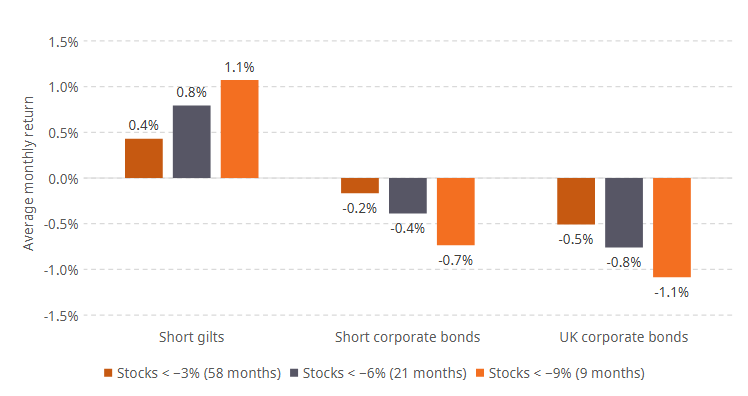
Figure 1: Average monthly bond returns when global equities are under stress. Source: Albion Research Indices. https://smartersuccess.net/indices
Of course, this is historical data, not a promise about what will happen next time markets fall. But it does illustrate an important point: the type of bond you hold can make a real difference when markets become uncomfortable.
Give each part of your portfolio a job
There is a simple principle behind all of this.
If equities are there to provide long-term growth, the defensive part of your portfolio should be built to provide defence.
That doesn't mean bonds should never be expected to deliver a reasonable return. Nor does it mean that every investor should hold exactly the same mix of investments.
But it does mean being careful about chasing extra yield at the expense of the very qualities you wanted from bonds in the first place.
There is no free lunch in investing. Higher potential returns usually come with additional risks. The important thing is understanding where those risks sit and whether they are helping you achieve your objectives.
For us, there is considerable merit in keeping the core defensive allocation focused on high-quality, shorter-dated bonds.
They may not be the most exciting investments in the portfolio. They probably won't make for thrilling dinner-party conversation.
But that's rather the point.
Let bonds be boring. Take your risk in equities.
A final thought
Good investment portfolios aren't necessarily the ones where every holding is trying to deliver the highest possible return.
They're the ones where everything has a purpose, and where the different parts work together.
Sometimes the most valuable investment decision is not about finding something more exciting. It's about resisting the temptation to make something boring do a job it was never designed to do.
This article is for information and educational purposes only. It is not personal investment advice. The value of investments and the income from them can fall as well as rise, and you may get back less than you invest. Past performance is not a reliable indicator of future results.