
There is something rather revealing about the way we respond to investment performance.
When markets are rising and portfolios are doing well, confidence can quickly become complacency. When returns disappoint, discomfort can turn into doubt almost overnight.
Why are we behind the S&P 500? Why has the FTSE 100 done better? Why do we own this particular investment at all? Wouldn’t it be easier simply to hold whichever index is currently leading the pack?
These are perfectly reasonable questions. The problem is not asking them. The problem is allowing a short period of performance to provide the entire answer.
Perhaps there is a more useful question:
Is the portfolio still behaving as intended?
That subtle change of emphasis takes us away from reacting to the latest performance figures and back towards the purpose of the portfolio.
It also helps us manage one of the most difficult elements of investing: our own behaviour.
The chart below brings this idea to life. It shows how some of the broad decisions within a portfolio similar to yours have affected returns so far this year.
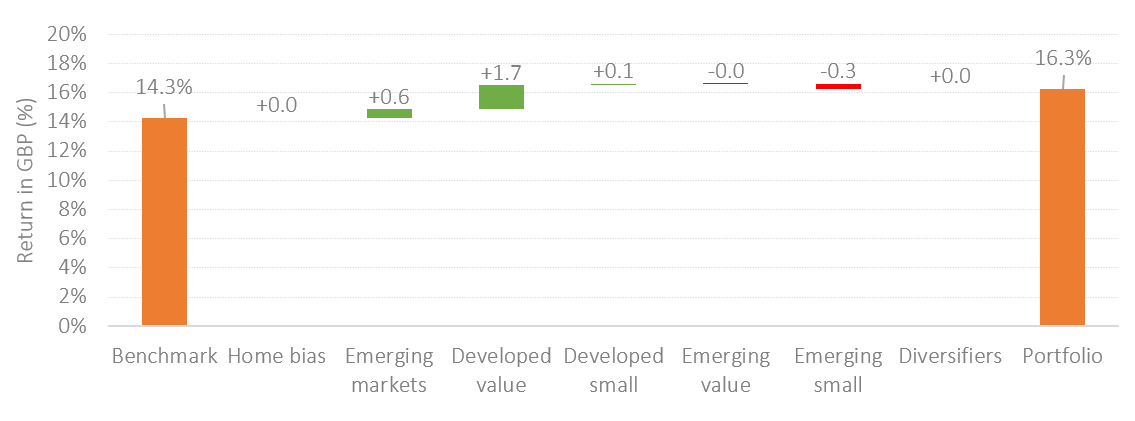
Figure 1: YTD attribution - waterfall chart of an example systematic portfolio
Source: Albion Strategic Consulting. Data: YTD cumulative performance, January 2026 to September 2026. Data in nominal terms, in GBP.
A portfolio is a collection of deliberate decisions
Every diversified portfolio reflects a series of choices.
How much should be invested in shares and how much in bonds? Should it include emerging markets? Is there a case for favouring smaller companies or attractively valued businesses? Should additional diversifiers be included to make the overall journey less dependent on one particular market?
Each decision means the portfolio will look different from a familiar benchmark. If it is structured differently, it will inevitably perform differently too.
That difference will sometimes be welcome. At other times, it will be uncomfortable.
The objective is not to construct a portfolio that will always have looked perfect with the benefit of hindsight. It is to build one that gives the investor a reasonable chance of remaining invested and achieving a successful long-term outcome.
Not everything should perform well at once
A genuinely diversified portfolio contains investments with different characteristics and different jobs to do.
We should therefore expect periods when certain parts of it perform strongly while others appear disappointing. If every holding behaved identically, the portfolio might not be as diversified as it first appeared.
A negative contribution from one part of a portfolio does not automatically indicate that something has gone wrong. Equally, a positive contribution does not necessarily prove that the original decision was correct.
It simply tells us what happened during that particular period. It does not, on its own, tell us what is likely to happen next.
This distinction is especially important when considering investment approaches designed around long-term evidence.
For example, a portfolio may deliberately allocate more to certain types of companies because the evidence suggests they offer higher expected returns over sufficiently long periods, while providing additional diversification. That does not mean those companies will outperform every year, or even over every several-year period.
Judging the decision solely by its most recent return tells us very little about whether its original rationale remains sound.
A better way to review investment decisions
When one part of a portfolio has underperformed, three questions can help us assess it more constructively.
1. What was this investment intended to do?
Was its role to generate long-term growth, provide income, reduce overall risk, protect against a particular economic environment or diversify exposure away from the largest companies and markets?
It is difficult to judge whether an investment has succeeded if we have forgotten why it was included in the first place.
2. Does the original rationale remain intact?
Evidence can change. Investment products can change. Costs can become uncompetitive and a client’s objectives or circumstances can evolve.
If the evidence supporting a decision has weakened, the investment no longer fulfils its intended role or the investor can no longer tolerate the associated trade-offs, then the portfolio deserves to be challenged.
3. Would we make the same decision again?
Imagine being taken back to the point at which the portfolio was constructed, equipped only with the information that was reasonably available at that time.
Would we still make the same choices?
If the answer is yes, short-term underperformance alone may not provide a compelling reason to change course. If the answer is no, we should understand precisely what has changed and whether action is required.
Good change and bad change
There are many legitimate reasons to change a portfolio.
Your objectives may have changed. You might be approaching retirement and require a different balance between growth, income and capital stability. Your capacity to absorb losses may have reduced. Tax rules, costs or available investment options may have altered. The evidence supporting a particular approach may also have evolved.
These are all reasons for a disciplined review.
What is usually less helpful is changing strategy simply because another market or investment has recently performed better.
That can result in selling what has disappointed after it has fallen behind and buying what has already performed strongly. The portfolio then becomes a collection of yesterday’s winners rather than a strategy designed around tomorrow’s needs.
The role of an Investment Committee
A robust investment process should not defend every existing decision indefinitely. Nor should it react to whichever parts of the market have most recently performed well.
The role of an Investment Committee is to keep challenging both the portfolio and the reasoning behind it. This includes reviewing whether each decision still has a sound rationale and understanding why the portfolio behaves differently from its benchmark.
The essential distinction is between discipline and inertia.
Discipline means remaining committed to a sound strategy when it is temporarily uncomfortable.
Inertia means refusing to make changes even when the evidence, objectives or circumstances have genuinely moved on.
A good governance process should help investors tell the difference.
Returns matter, but they are not the whole story
None of this means investment returns are unimportant. Returns are ultimately necessary to fund spending, protect against inflation and support future goals.
But performance should be assessed as part of a much broader picture.
Did the portfolio take an appropriate level of risk? Did diversification work when it was needed? Was sufficient cash available to avoid selling investments at an unfortunate time? Did the portfolio support the client’s withdrawals? Most importantly, did the investor remain comfortable enough to stay with the plan?
A portfolio built differently from the wider market will inevitably produce different returns from time to time. The decisive test is whether it remains appropriately positioned to meet the investor’s goals and whether they can continue to hold it through the inevitable periods of uncertainty.
The takeaways
The next time you look at your portfolio and feel disappointed that one element has fallen behind, try resisting the urge to begin with:
“Why didn’t we own more of what performed best?”
Instead, ask:
“Did the portfolio behave in the way we expected, and does the reason for owning each part of it remain intact?”
That question may not remove the discomfort of underperformance, but it places the decision back where it belongs: within your long-term financial plan, rather than at the mercy of the latest market league table.
If you would like to explore any of the concepts shown in this blog, feel free to get in touch via the button below.