Bonds: the basics

This is the first note in my new Back to basics series: “Bonds: the basics.”
This new collection of articles is designed to explain some of the core concepts in investing in a clear and accessible way. The aim is to provide useful material that support clients’ understanding of important investment principles.
This first note focuses on bonds - what they are, how they work, why they are often described as “fixed income”, as well as the types of bonds included in sensible investment portfolios.
Bonds: the basics
We often associate the term ‘bond’ with mutual connection, whether the subject is chemistry (between atoms, ions, or molecules), personal relationships (between human beings), or finance (between borrowers and lenders). In finance, bonds are often considered difficult to understand, shrouded in complex mathematics and technical terminology. In reality, the basic concept is quite straightforward.
In their simplest sense, bonds are IOUs set up between borrowers and lenders. At the outset, the borrower determines how much they wish to borrow, for how long, and the fixed amount they are willing to pay the lender – typically once or twice per year – as appropriate compensation for borrowing their money.
For this reason, bonds are also known as fixed income securities. The simple example below illustrates why bonds also carry this name. The future cash flows a lender receives are fixed and predictable, provided the borrower does not default.
At the outset, a sum is lent. Each year, an amount is paid to the lender (the coupon) and at the end of the term the original sum (the principal) is returned.
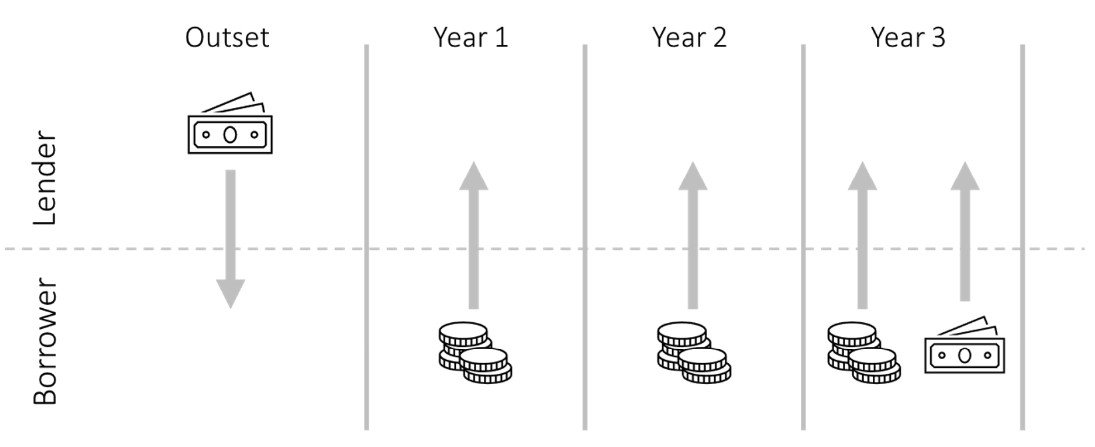
Figure 1: Simple illustration of a 3-year bond with an annual coupon | Source: Albion Strategic Consulting
Borrowers, also known as bond issuers, predominantly comprise governments and companies around the world. A significant difference between bonds and more traditional loans is that bonds are marketable. In other words, the lender in the IOU agreement can sell the right to receive the cash flows to someone else. This is why the lender will more commonly be referred to as the bondholder.
The relationship between risk and return still applies to fixed income. If the borrower is a large, developed government it is highly likely that bondholders will be repaid and so the government can offer lower coupons. Examples include the US, the UK, Australia, the Netherlands and Germany. Bonds issued by many developed-market governments and financially stronger companies are commonly referred to as investment grade. In plain English, this means they are judged to have a relatively low risk of default.
By contrast, a company on the brink of financial collapse would have to offer much higher compensation to encourage lenders. Such bonds are known as high yield bonds, and they carry a higher degree of uncertainty over whether future cash flows will be paid in full and on time.
Assessing the ability of companies or governments to repay lenders is a complex process for investors. Thankfully rating agencies do some of the heavy lifting. Data from S&P, a rating agency, show that, on average between 1981 and 2025, 26% of bonds with the lowest rating of CCC/C defaulted within the next 12-month period, whereas for those rated highest at AAA that figure was zero.
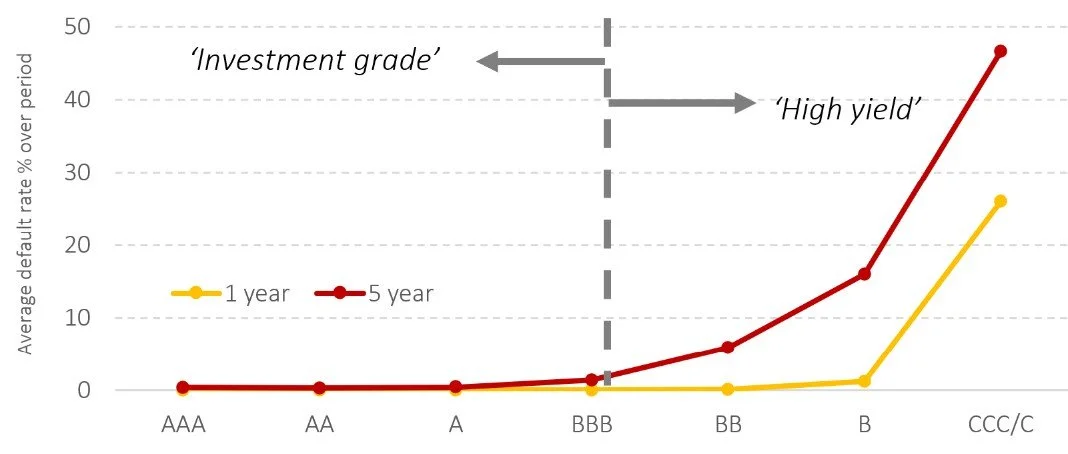
Figure 2: % of global corporate bond defaults after 1 and 5 years, 1981-2025 | Data source: S&P (2026). “Default, Transition, and Recovery: 2025 Annual Global Corporate Default And Rating Transition Study”. Rating refers to rating at outset of respective period.
It is clear that investment grade bondholders have historically been considerably more likely to receive their capital back than high yield bondholders (sometimes referred to as ‘junk’ bonds).
The astute reader might reasonably question whether high yield bonds could therefore act as a core return driver in an investment portfolio, given the higher risk. However, stocks typically act as a more productive driver of returns, and so are a preferred route for growth. As a result high yield bonds may not sit comfortably in a portfolio built to provide a good chance of long-term investing success.
In 2008 – the Credit Crisis – high yield bonds performed similarly to stock markets, but over the longer term have delivered a significantly lower annual return than stocks. Higher-quality bonds might not have enjoyed the impressive returns stocks have offered, but they did provide a valuable safe haven during the economic crisis in 2008 as investors fled to safety.
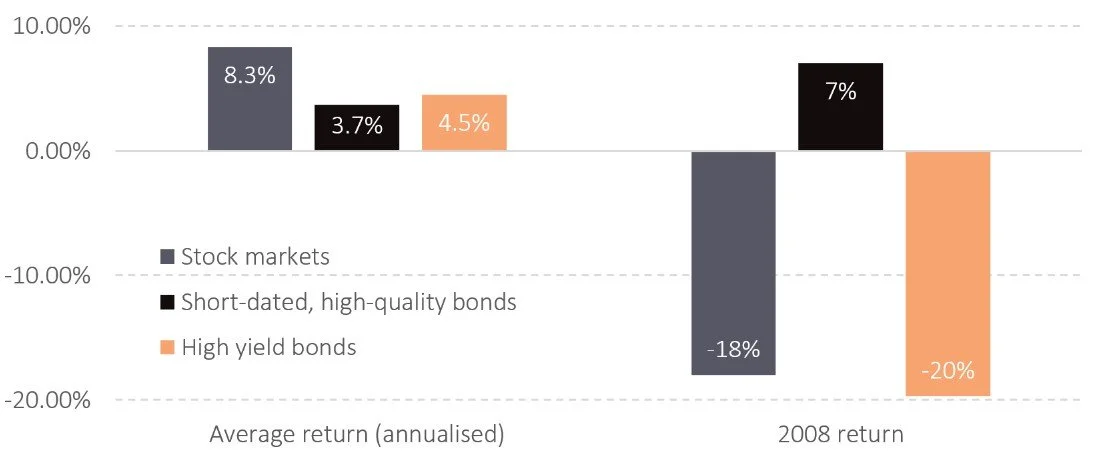
Figure 3: High yield bonds have offered stock-like drawdowns without the upside | Source: Albion Strategic Consulting. Data source: Albion Research Indices, Albion Developed Stock Market Index, Albion Global Short Bond Index (0-5, GBP), Albion Global High Yield Bond Index (GBP) (see smartersuccess.net/indices for more information). Nov-98 to Jun-26, in GBP, nominal terms.
For this reason, we allocate the fixed income element of your portfolio to investment funds that diversify across many different creditworthy, investment grade bonds. We refer to this part of the portfolio as the ‘defensive assets’.
The key takeaways
A bond is an IOU between a borrower, such as a government or company, and a lender. The ownership of this IOU can be traded between lenders (bondholders), and with it the right to receive the cash flows from the borrower.
The main features of a bond are the maturity (i.e. the term of the loan) and credit quality. The latter is assessed by rating agencies and gives an indication of a borrower’s creditworthiness.
Investment grade bonds provide greater certainty of future payments to lenders than high yield bonds. A shorter lending term also generally corresponds to greater certainty of repayment. For this reason, we consider sensibly structured portfolios typically allocate to shorter-term, higher-quality bonds within their defensive assets.
If you found this article of interest or would like to understand the role bonds could play in your own portfolio, please feel free to get in touch via the link below.