Investing at all-time market highs

Stock markets reaching all-time highs can feel both reassuring and unsettling. On the one hand, rising markets are a sign that long-term investors are being rewarded for taking on the risks that come with stock ownership. On the other, new highs can prompt the understandable question: is now the wrong time to invest, or the right time to take some money off the table?
This feeling is entirely natural. Long-term savings are invested to protect – or hopefully grow – purchasing power. When markets have already risen, it can feel intuitively sensible to wait for a seemingly inevitable fall, or lock in recent gains before they disappear. Of course, it makes little sense to be invested right before a downturn.
However, the problem is that what can feel emotionally sensible is not always good investor behaviour. Moving in and out of markets requires getting two decisions right: when to leave and when to get back in. That is difficult enough once, and harder still to repeat successfully over a lifetime of investing. Few professional investors have demonstrated an ability to time markets consistently, even with teams of analysts, sophisticated systems and constant access to information.
A more useful starting point is to act as if markets are broadly efficient; that is to say prices reflect the combined views of millions of investors processing information in real time. This does not mean markets are perfect, or that they will not fall. They will. It does, however, mean that today’s prices already incorporate a great deal of collective judgement about what the future holds. Trying to second-guess that collective view gives investors a much lower probability of success than staying invested in a well-diversified portfolio aligned with their long-term goals.
All-time stock market highs are also not unusual. Markets rise over time because companies innovate, are profitable, reinvest capital and adapt to a changing world. If markets are expected to deliver positive returns over the long run, then new highs should be expected along the way. In fact, since 1990, developed stock markets have hit highs over 650 times, as the figure below demonstrates.
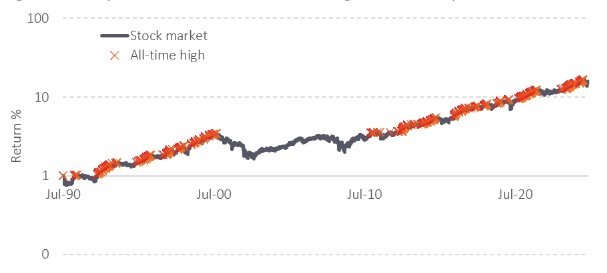
Figure 1: Develop stock market returns and all-time highs, Jul-90 to May-26. Source: Albion Developed Stock Market Research Index, Jul-90 to May-26, daily returns in GBP. For illustrative purposes only.
The sensationalist news headline that ‘markets have hit an all-time high’ should be taken with nothing more than a shrug of your investment shoulders. It’s how markets work.
Research from JP Morgan (2020) demonstrated – perhaps counterintuitively – that average returns from investing in the S&P 500 index (the largest 500 stocks in the US) from January 1988 to August 2026 would have yielded better results by investing at market highs rather than on a randomly chosen day.
Investing on a randomly selected day would have led to a positive return in the next 12 months 83% of the time. Investing on the day of an all-time high would have led to a positive 12-month return 88% of the time. The average returns were also higher when investing at market highs, and this was also the case for 3- and 5-year outcomes.
While there is no guarantee that the next 1-, 3-, or 5-year stock market outcome will follow the average outcomes outlined in the research above, this does demonstrate that there is no certainty that market highs are followed by subsequent falls.
A sensible way to navigate constantly changing and unpredictable stock market sentiment is to own a portfolio that systematically tilts towards global companies that provide a better diversified solution, such as smaller and value-oriented companies. Importantly, a good financial planner will ensure that you are invested in the right blend of stocks and bonds to meet your appetite, capacity and need to take on risk.
Market falls are expected and factored into the cashflow modelling process and expected investment outcomes. Unfortunately, there is no way to predict when these falls will happen, and stock markets reaching all-time highs provides no further insight either.
Stay invested.